
👋🏽 Introduction#
IMPORTANT
The course is freely available on this website. There are no online or hybrid meetings. If you just want all of the course materials and not participate in the course any longer, please unenroll from Brightspace. Thank you.
Welcome to Metropolitan Data1 (YMS31303) at the AMS. The course is taught by Dr Theodoros Chatzivasileiadis and Ir. Hans Hoogenboom with the support of a fantastic team of teaching assistants.
Instructor Details#
Dr. Theodoros Chatzivasileiadis
Assistant Professor in Urban Science & Policy
B2.390, Building 31
Faculty of Technology, Policy and Management
Jaffalaan 5
2628 BX Delft
The Netherlands
Email: T.Chatzivasileiadis@tudelft.nl
Ir. Hans Hoogenboom
Lecturer in Design Informatics
BG.West.290, Building 8
Faculty of Architecture and the Build Environment
Julianalaan 134
2628 BL Delft
The Netherlands
Email: j.j.j.g.hoogenboom@tudelft.nl
Schedule#
A detailed schedule of the course is provided here.
Locations#
All lectures, labs, discussions, and office hours will be hosted in person.
Physical location information is mentioned in Brightspace calendars. All meetings will take place at the AMS Institute.
Virtual There are no online or hybrid meetings.
Announcements will regularly be made on Brightspace.
Teaching Assistant Support#
Teaching Assistant |
Role |
|
|---|---|---|
Ka Yi Chua |
Lab |
Course Language#
English & Python
Why Python#
General purpose programming language
“Sweet spot” between “proof-of-concept” and “production-ready”
Industry standard: GIS (Esri, QGIS) and Data Science (World Bank, OECD, The Atlantic, Gemeente Den Haag…)
It almost reads as English
Expected prior knowledge#
Some prior programming experience is helpful but we presume you have never programmed before. That being said, this course is not about learning how to program, it is about becoming responsible data scientists. To achieve this we need to use advanced Python libraries. So, at the beginning of this course you might feel like we have thrown you in the deep end of the pool. To ease your pain, we do provide a self guided introduction into Python as well as a link to a free online beginners Python course. Additionally, we will have walk-in hours where you can consult the Teaching Assistants with any Python questions. We will not let you drown.
For students who have had statistical, math or computer programming courses in their bachelors or elsewhere, this course will add to your skills by providing you with tools to become future policy-makers, data scientists, and in general, supporters of open science. The course will offer some uncertainty in terms of what is a problem and how it can be solved. If you are willing to embrace that uncertainty, we will learn about the fundamentals of spatial data science. We may even discover new ways of designing equitable urban spaces, from neighbourhoods and cities to entire regions.
Philosophy of the course#
(Lots of) methods and techniques
General overview
Intuition
Very little math
Lots of ways to continue on your own
Emphasis on critical thinking, application and use
Close connection to real world applications
Feedback strategy#
The students will receive feedback through the following channels:
Formative Feedback weekly general feedback on labs by TAs and direct interaction with the instructor and teaching assistants in the lectures and labs.
Summative Feedback as graded assessment of four summative assignments and the final project. This will be in the form of reasoning of the mark assigned as well as comments specifying how the mark could be improved. This will be provided before the submission of the next assignment is due so students have the chance to incorporate the feedback in their work.
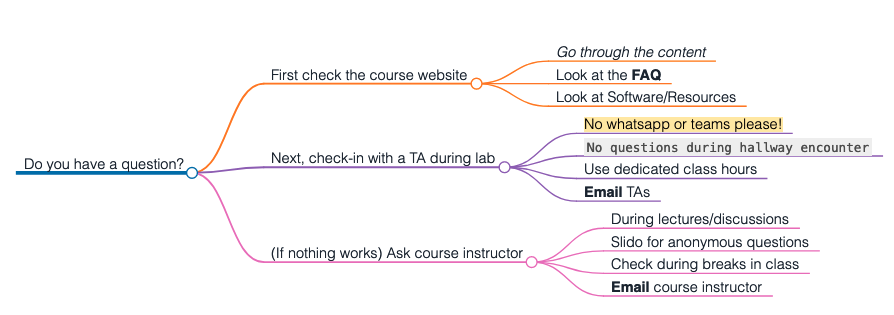
Questions#
This course is about learning to learn, so if you have a question, follow the process laid out below for the most efficient and organised way of learning.
Key texts and learning resources#
Access to materials, including lecture slides and lab notebooks, is centralized through the use of a course website available through the following url:
https://jhoogenboom.github.io/spatial-data-science/_index.html
Specific readings, videos, and/or podcasts, as well as academic references will be provided for each lecture and lab, and can be accessed through the course website.
Acknowledgement#
This course is based on, or more precise, a condensed copy of, the course EPA 122A - Spatial Data Sciences from Associate Professor Trivik Verma at the TU Delft. Consecutively, his course has been developed using research, input from colleagues at the faculty of Technology, Policy and Management at TU Delft and a few open-source teaching resources on the web. He is incredibly grateful to these developers for offering information openly:
Arribas-Bel, D. (2019). A course on geographic data science. Journal of Open Source Education, 2(16), 42.
Lab Materials extended from Introduction to Data Science taught at Harvard University by Pavlos Protopapas, Kevin A. Rader, and Chris Tanner.
All open-source material from Geoff Boeing at USC’s Sol Price School of Public Policy.
Discussions with Francisco Rowe, Caitlin Robinson, Clara Peiret-Garcia, Juliana Goncalves, Anastassia Vybornova, Ruth Nelson, Nazli Aydin and so many students.
License#
Unless otherwise stated, all content on this website, including all teaching material, is licensed under a Creative Commons Attribution-ShareAlike 4.0 International License.